The following
is an outline of the term two design lecture by Sean Hall.
I take out the more important point of each lecture and try to extended with
the inclusion of excerpts and images from Fiske, J (1990) an Introduction
to Communication Studies, London: Routledge, esp
I also include (please see menu) the course work that we were asked to
produce for this design course.
In a second state, I commente my portfolio which includes the three sites
made for the Noemi Sadowska’s design class. Those comments will be
found in the ‘eveluation’ section of each ‘project’

Week1: Interpretation and communication
(Excerpts and image from Fiske, J (1990) an Introduction to Communication
Studies, London: Routledge, esp Ch.3)
C.S. Pierce Model is form of 3 elements:
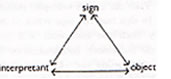
“a sign that refers too something other
that itself – The object, and is understood
by somebody: that is, it has an effect in the mind of the user – the
interpretant
The doubled-ended arrows emphasize that each term can be understood only
in relation to the others ”
For Saussure, society and not the individual, was the primary form of reality.
Human consciousness, action and language were not the product of the individual,
but product of society.
Signifier + Signified = Sign
Signifier is the thing that carries the message and the signified is the
message itself. All sign consist of a signifier and a signified. However,
there is different set of relations which operate so as to create meaning
and give us three basic types of sign.
•Icon: relation of resemblance
•Index: casual relationship
•Symbol: arbitrary relationship
Week2: Image and Text
The different kinds of visual production can have various
key features.
They include:
•The form of the image
• Structures: composition and framin
• Devices: perspective
• Elements: colour, tone, texture and line
•The content of the image
•The form of the text
•The content of the text
Barthes: the meaning of an image is always
related to the text with which interacts. Images are too polysemous. So
we secure the meaning of an image by using words with it. Words provide
anchors for images
There is two basis relations between text and image
•Verbal text extends the meaning of the image and vice versa: different
meaning is created.
•Verbal text elaborates the meaning of the image and vice versa: same
meaning is restated.
Elaboration is more common. There is two basis
kind of elaboration.
•The text comes first and the image forms an illustration of its meaning.
•The image comes first and the text forms a way of anchoring its meaning
Kress and van Leeuwen maintain that image and text are largely autonomous.
In a multimodal text (image + text the image can carry an message whilst
the text can carry another
Week3: Image and Text II
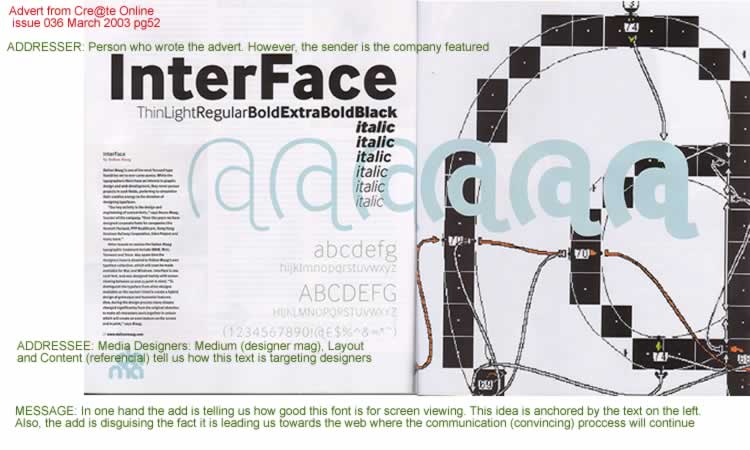
In addition to elements like Addresser, Message, addressee,
there are others that may help us to understand the system of signs. We concentrate
in a comprehensive version of the model of Roman Jacobson
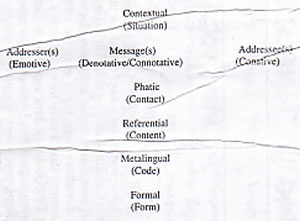
•Addresser(s) : Where
the message says it is coming from. This may be rather different from the
Sender which it is its actual source.
Emotive : Is the intended massage/meaning What the Addresser wants to say.
•Addressee(s) : Where the message is going.
This may be different from the Receiver which is its actual destination.
Conative : Is what is received/interpreted in
the message . To some extent fashioned by what the receiver wishes to hear.
•Message/(Denotative/Connotative) : What
the message actually is/how it is composed etc.
•Denotation : First order of signification
- working between signifier and signified in the sign and its reference in
external reality. The common sense, obvious meaning of the sign.
•Connotation : Second order of signification
•Phatic/Contact: Relationship between the
addresser and the addressee
•Referential/Content: The things that are
contained in the message.
•Metalingual/Code: The codes for interpreting
the message.
•Formal/Form (Poetic): The way in which
the communication is set out .
•Contextual: The situation or context in
which the message operates


Week4: Sign and System
Exercice:
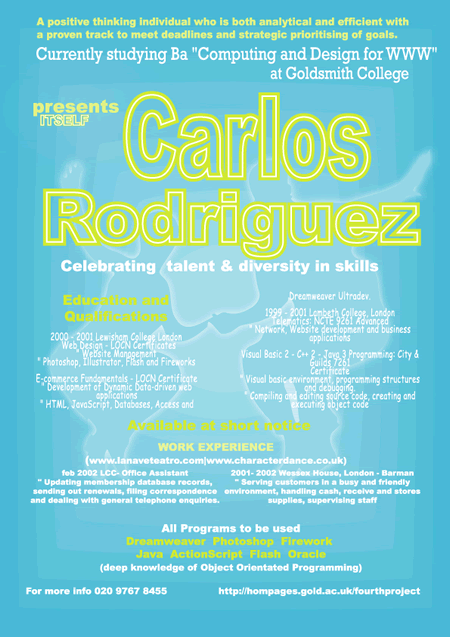
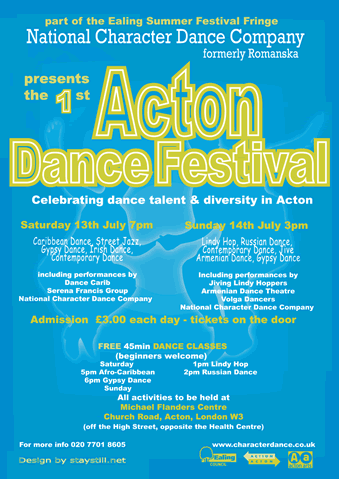
Using a different 'langue' into CV 'parole'
•
Langue is a technical
term that denotes the code, system or language that is being used
•
Parole is about the particular utterance
or speech act that is produced
Semiotics is about the system (langue) that underlies certain types of utterance
(parole), we need to be aware of what sort of system we are dealing with in
each case of parole
Langue is organise in two axes
1. - the choice or selection of interchangeable parts
Paradigm is a set of sign any of which can be
chosen and interchanged in a given context.
2. - the combination of elements according to certain rules
Syntagm is an ordered set of sign any of which
ca be combined according to certain rules.
So a syntagm is a set of element of a paradigm + rule
Week5: Mental Process
In lecture we spoke about the different form of Barthes’s
symbolic: metaphor, metonym and simile. I included here also the concept of
connotation and denotation (that originally were included in week 8), doing
so I manage to put together Barthes’ set of ideas included in chapter
5 and 6 of Fiske book
(Excerpts from Fiske, J (1990) an Introduction to Communication Studies, London:
Routledge, esp Ch.5)
“Meaning: a process of negotiation write/reader and test. Roland Barthes,
who first set up a systematic model by which this negotiating, interactive
idea of meaning could be analysed. At the heart of Barthes’s theory
is the idea of two order of signification.
Denotation
The first order of signification. It describe the relationship between the
signifier and signified within the sign, and of the sign with its referent
in external reality. It refers to the common-sense, obvious meaning of the
sign.
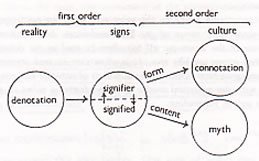
Connotation
1st way of the second order of connotation
It describes the interaction that occurs when the sign meets the feelings
or emotions of the users and the values of their culture. It is when the
meaning move to the subjective. It is when the interpretant is influenced
a s much by the interpretant as by the object or the sign.
In a photograph, denotation is what is photographed; connotation is how
it is photographed
Connotation is largely arbitrary, specific to tone culture, though it frequently
has an iconic dimension. In the photograph example give by Fiske, we need
the conventional element to decode in this way, to know that soft focus
is a significant choice made by the photographer, and not a limitation of
the equipment. If all photographs were in soft focus, then it could not
connote nostalgia
Because connotation works on the subjective level, we are frequently not made
consciously aware of it. It can all too often be read as the connotative meaning.
It is often easy to read connotative values as denotative facts. One of the
aims of semiotics analysis is to provide us with the analytical method and
the frame of mind to guard against this sort of misreading
Week5: Mental Process
Myth
2nd way of the second order of connotation
Barthes uses it as a believer, in its original sense. A myth is a story by
which a culture explains or understands some aspect of reality or nature.
A myth is a culture’s way of thinking about something, a way of conceptualizing
or understanding it. It exists before the sign, and the sign activates the
chains of concepts that constitute the myth.
If connotation is the second order meaning of the signifier, myth is the second-order
meaning of the signified
Barthes argues that the main way myths work is to naturalize history. This
points up the fact that myths are actually the product of a social class that
has achieved dominance by a particular history: the meanings that its myths
circulate must carry this history with them, but their operation as myths
makes them try to deny it and present their meanings as natural, not historical
or social. Myths mystify or obscure their origins and thus their political
or social dimension.
The mythologist reveals the hidden history and thus the socio-political
works of myths by 'demystifying' them.
Myths can most effectively naturalize meaning by relating them to some aspect
of nature itself.
Myths do not reject the old entirely, but drop some concepts from their chains,
and as others: change in myths is evolutionary, not revolutionary.
No myths are universal in a culture. There are dominant myths and there are
also counter-myths
The other aspect of myths that Barthes stresses is their dynamism. They change
and some can change rapidly in order to meet the changing needs and values
of the culture of which they are a part.
Connotation and myth are the main ways in which signs work in the second order
of signification that is the order in which the interaction between the sign
and the user/culture is most active.
Symbols
Barthes (1977) does refer to a third way of signifying in this order. The
symbolic. An object becomes a symbol when it acquires through convention and
use a meaning that enables it to stand for something else.
Week5: Mental Process
Metaphor
It works by transposing qualities from one plane of reality to another, expressing
the unfamiliar in terms of the familiar. The jargon terms are ‘vehicle’
for the familiar, ‘tenor’ for the unfamiliar.
But metaphor are not just a literary devices: Lakoff and Johnson(1980) have
shown that they have a much more fundamental, everyday experience( up: positive
meaning; down: negative meaning). There is nothing natural that links high
social position, high earnings, and high morals, but making sense of them
through the same metaphor is one way in which the dominant values are spread
throughout society.
Such everyday metaphors differ from literary metaphors in a number of ways.
They do not draw attention to themselves as metaphors, and thus do not invite
us to decode them consciously.
They are thus more insidious, and the sense that they make
becomes more easily part of our society's 'common sense'; that is, it becomes
part of the uninspected, taken for granted assumptions that are widespread
throughout society.
Such common sense appears to be natural, but it never is: it is always socially
produced. It is, then, finally, ideological: the power of the dominant classes
is maintained partly to the extent that their ideas can be made into the common
sense of all classes.
Metonymy
It works by associating meaning in the same plane. Its basic definition
is making a part stand for the whole.
The selection of the metonym is clearly crucial, for from it we construct
the unknown remainder of reality. The selection of metonym determines the
rest of the picture of the event that we construct
In the lecture we also spoke about the simile
Simile : a stated comparison (like/as) between
two different objects, images, ideas or likeness. Simile is cliché
ridden
Week5: Mental Process
(Excerpts from Fiske, J (1990) an Introduction to Communication
Studies, London: Routledge, esp Ch.6)
“Norm and Deviation
A norm is statistically average example of behaviour or evaluation. It describes
the common practices of a group or society and is thus predictable, the expected.
The unexpected, the non-conventional is a deviation from the norm.
'A Grief Ago' is a deviant use of language in that the syntagm: A... AGO is
normally completed by one of a set of words with particular characteristics,
that is, words from a particular paradigm. In this characteristics of the
normal paradigm are.
(a) words concerned with the measurement of time;
(b) words concerned with regularly recurring events;
(c) words with a plural form.
Thomas has temporarily given it the characteristics of its
new paradigm, While retaining those of its original one - that of major emotions.
By investing grief with the characteristics of measuring time, regular recurrence,
and plurality, he has given the word a new set of meanings that many readers
find particularly apt or imaginatively pleasing.
Creativity or originality frequently means breaking norms or conventions and
emiotic analysis can help us to understand what norms are being deviated from,
to what extent, and, possibly, to what effect.
Those examples (see book for reference) are working metaphorically, in that
they are taking units from one paradigm and inserting them into a syntagm
which would normally be completed by units from another. By so doing they
are associating the characteristics of the two paradigms in a new and imaginatively
striking way by the process of transformation. All metaphors are, in this
sense, deviations from the norms of language behaviour.”
Week7: Decoding Advertisements
The work advertising comes from the Greek meaning turn towards
Advertising is a form of discourse (Parole). It has its own way of communication.
The most basic model for this form of communication will have the following
three elements: Addresser(s) Message(s) Addressee(s)
The basic idea of this model is to establish who is sending a message to whom
and what the message means. The addresser in this case is the individual or
thing that communicates the message (i.e. the addresser is where it says it
is from, as opposed to the Sender, which is its actual source) and the addressee
(i.e. the addressee is where it says it is going, as opposed to the Receiver,
which is its actual destination) is the individual or group of individuals
who are trying to understand the message. The message consists of the meaning
that is communicated by the addresser and received by the addressee
Notice that there may be more than one addresser, more than one message and
more than one addressee
The Structures of Textual Meaning
a) How is the text read and understood? (i.e.
what are its graphological features and semantic features?)
•
Paralanguage. aspect
of communication that work alongside, surround or support text. There are
all-important forms of non-verbal communication tell us how to understand
the pieces of text we are trying to interpret.
•
Positioning. This concerns
whether the text is read from the top down or from the bottom up.
•
Voice. This is about
which pronoun(s) is employed in the text. (we, I..) In tackling the question
b) it is useful to identify key features of how language can sound and what
this might serve to communicate. The most interesting elements are:
Week7: Decoding Advertisements
b) How does the text sound?
(i.e. what are its phonological features?)
•Prosodic features. These
are aspects of stress and intonation. ( typographical features, size and shape,
different stylistic features and by aspects of punctuation)
•Fluency and Non-fluency features.
Fluency concerns the extent to which it does not flow.
•Accent. This may be represented
by (say) an alteration of spelling •Vocabulary. It is possible
to give this feeling by using everyday conversation, and regional accents.
•Repetition. This is often
used in stories designed for children to emphasise point that are important.
It can, however, be used successfully in adverts.
•Grammar. Grammar
concerns the way in which the sentences are constructed. This may also tell
you something important about the age, gender, social class, and ethnicity
of the persons involved.
•Interactive markers.
These are aspects of language that result from the fact that language is interactive.
Overlaps, interruptions, reinforcements that indicate understanding or a lack
of It (noises such as 'mm', 'urn', 'er', 'oh', 'yeah', 'ugh', 'eek' and 'aargh'),
and monitoring expressions (phrases such as ‘you know’) all can
act as interaction markers.
•Topic changes. Here we
should notice the frequency with which there-are topic change
A Note on Intertextuality
Intertextuality is about how one visual or verbal text relates to another
visual or verbal text.
Week7: Decoding Advertisements

Reinforcing the sign and its relation between signifier and signified: including
the signified into the signifier.
It is not that the signifier means arbitrarily, in the case, ‘action
of hide’ is that the signifier is doing that action and doing so reinforces
its meaning.

Second example works in
a very similar way
Visual correspondence between words
and picture:
oxymoron, rebuses. palindromes, tropes, acronyms, anagrams, lipograms, macronics,
onomatopoeia, noncewords, stinky pinkies and Tom Swifties.
A stinky pinky, is a noun modified by an alliterative
rhyming adjective. Shapes can rhyme as well as sounds.
A pun plays on the different meanings attached
to one word. It is an amusing use of a work or phrase which has several meaning
or which sounds like another word
A Tom Swifties is a phrase in which a verb or
adverb supplies the pun. For instance, 'Thank God I remembered to take my
umbrella,' he drily observed.
An anagram is changing the order of the letters
forming a word or phrase, to create another: for instance total abstainers
can be happily re-arranged to sit not at ale bars.
Rebus comes from Latin, non verbis sed rebus,
meaning, 'not by words but by things'. A rebus is a puzzle in which letters,
syllables or words are replaced by visual images such as symbols and pictures.
An anonym is a name written backwards. The concept
is not as pointless as it may seem.
Week8: Ideology and Meaning
Excerpts from Fiske, J (1990) an Introduction to Communication
Studies, London: Routledge, esp Ch.9
“
Signification and culture
How do these second order meanings fit with the culture within which they
operate? Where do the myths and connotations arise
The reader and the text together produce the preferred meaning, and in this
collaboration the reader is constituted as someone with a particular set of
relationships to the dominant value system and to the rest of society. This
is ideology at work.
Ideology
There are a number of definitions of ideology. Raymond Williams (1977) find
three main uses:
1. - system of beliefs characteristic of a particular
class or group.
2.- A system of illusory beliefs false ideas
or false consciousness which can be contrasted with true or scientific knowledge.
3.-The general process of the production of
meanings and ideas.
Use 1 This is closer to the psychologists use
of the word. Psychologists use 'ideology' to refer to the way that attitudes
are organized into a coherent pattern. Or, as Brockreide (1968) succinctly
puts it, 'attitudes have home in ideologies.
Use 2. Ideology, then, becomes the category
of illusions and false consciousness by which the ruling class maintains
its dominance over the working class. Because the ruling class controls
the main means by which ideology is' propagated and spread throughout society,
it can then make the working class see its subordination as 'natural', and
therefore right. Herein lies the falseness. These ideological media include
the educational, political, and legal systems, and the mass media and publishing.
The meanings generated by any one text are determined partly by the meanings
of other texts to which it appears similar. This is called 'intertextuality'.
Use 3 The three uses might almost be modelled
as Chinese boxes 1 is inside 2 which is inside 3. Ideology here is a term
used to describe the social production of meanings. Ideology, used in this
way, is the source of the second order meanings.
Signs: ideology: meanings
The signifier will be the same for both cultures, but the signified will
be differ significantly. And the difference in the signifieds is the difference
in the ideologies.
Week8: Ideology and Meaning
Ideology and signification
The only way their commonality can be established and maintained is by their
frequent use in communication. Every time a sign is used it reinforces the
life of its second order meanings both in the culture and in the user The
user of the sign keeps it in currency by using it, and maintains the myths
and connoted values of the culture only by responding to their use in communication.
The relationship between the sign and its myths and connotations, on the
one hand, and the user, on the other, is an ideological one
In using the signs we maintain and give life to the ideology, and by our
response to ideological signs
They enable members of a culture to identify their membership of that culture
through their acceptance of common, shared myths and values.
Ideology, then, in this third use, is not a static set of values and ways
of seeing, but a practice. Ideology constitutes me as a particular member
of my western science based culture by the very fact that I am able to use
and respond appropriately to signs, connotations, and myths. In anticipating
in the signifying practice of my culture I am the means by which ideology
maintains itself.
Understanding ideology
The theory of ideology as a practice was developed by Louis Althusser (1971)
For Marx, ideology was a relatively straightforward concept. It was the
means by which the, ideas of the ruling classes became accepted throughout
society as natural and normal.
According to Marx the ideology of the bourgeoisie kept the workers, or proletariat,
in a state of false consciousness. People's consciousness of who they are,
of how they relate to the rest of society, and therefore of the sense they
make of their social experience is produced by society, not by nature or
biology. Our consciousness is determined by the society we have been born
into, not by our nature or individual psychology.
The concept of ideology as false consciousness was so important in Marx's
theory because it appeared to explain why it was that the majority in capitalist
societies accepted a social system that disadvantaged them.
Althusser (1971) developed a more sophisticated theory of ideology that
freed it from such a close cause and effect relationship with the economic
base of society, and redefined it as an ongoing and all pervasive set of
practices in which all classes participate, rather than a set of ideas imposed
by one class upon the other. it does not mean that the practices themselves
no longer serve the interests of the dominant, what it means is that ideology
is much more effective than Marx: gave it credit for because it works from
within rather than without
Week8: Ideology and Meaning
One of the most ubiquitous and insidious ideological practices is what
Althusser calls 'interpellation' or 'hailing'. All communication addresses
someone, and in addressing them it places them in a social relationship.
In recognizing ourself as the addressee and in responding to the communication,
we participate in our own social, and therefore ideological, construction
Communication is a social process and must therefore be ideological: interpellation
is a key part of its ideological practice.
Another European second generation Marxist, Antonio Gramsci, introduced
into this area another term hegemony which we might like to think of as
ideology as struggle. Briefly, hegemony involves the constant winning and
rewinning of the consent of the majority to the system that subordinates
them. The two elements that Gramsci emphasizes more than Marx or Althusser
are resistance and instability.
Hegemony is necessary, and has to work so hard, because the social experience
of subordinated groups (whether by class, gender, race, age, or any other
factor) constantly contradicts the picture that the dominant ideology paints
for them of themselves and their social relations. In other words, the dominant
ideology constantly meets resistances that it has to overcome in order to
win people's consent to the social order that it is promoting. These resistances
may be overcome, but they are never eliminated. So any hegemonic victory,
any consent that it wins, is necessarily unstable; it can never be taken
for granted, so it has to be constantly rewon and struggled over. Whatever
their differences, all ideological theories agree that ideology 'I works
to maintain class domination; their differences lie in the ways in which
this domination is exercised, the degree of its effectiveness, and the extent
of the resistances it meets.
Week8: Ideology and Meaning
Displacement' is a term that
ideological theories have borrowed from Freudian dream theory: when a topic
or anxiety is repressed, either psychologically or ideologically, the concern
for it can only be expressed by being displaced on to a legitimate, socially
acceptable topic.
Another term used in ideological analysis is ‘Incorporation’.
This refers to the process by which the dominant classes take elements of
resistance from the subordinate and use them to maintain the status quo, rather
than to challenge it.
Yet another is ‘Commodification’.
Capitalism is the system that, above all others, produces commodities, so
making commodities seem natural is at the heart of much ideological practice.
Resistances
Hegemony is the means by which their consent to the system that disadvantages
them is won, but its victories are never complete or stable: because of
the contradictory experiences of everyday life the struggle is never over,
and any ground won by the dominant ideology has to be constantly defended
and actively held on to.
The theory of hegemony, however, extends this focus on the forces of domination
by encouraging us to look for moments of weakness in texts, for contradictions
in their ideological smoothness and coherence. While recognizing that these
forces will always attempt to incorporate resistance, it doubts the final
effectiveness of this strategy and argues that some traces of that resistance
will necessarily remain. These contradictions and traces of resisting meanings
may be identified by a hegemonic analysis of texts, but whether or not they
are actually taken up and acted upon can be established only by ethnographic
study.
The page must contradict itself in the same way that the social experience
of the subordinate contradicts the meanings that the dominant ideology proposes
for them. Hegemony theory argues that the ideological work of this page
to win the consent of young women to patriarchal capitalism is not just
an ideological practice but an ideological struggle, and that signs of the
resistances it has to overcome can never be wiped out, that some always
remain to fuel more resistance in the future.”
Week9: Empirical Applications in Semiotics
(Excerpts from Fiske, J (1990) an Introduction to Communication
Studies, London: Routledge, esp Ch. 8)
"These critics would argue that semiotics does not have an empirically
validated base of evidence upon which to rest its theory. The aims of empiricism
are: to collect and categorize objective facts or data about the world; to
form hypotheses to explain them; to eliminate, as far as possible, any human
element or bias from this process; and to devise experimental methods to test
and prove (or disprove) the reliability of the data and the hypotheses.
Content Analysis
It is designed to produce an objective, measurable, verifiable account of
the manifest content of message. It analyses the denotative order of signification
Content analysis must be non-selective: it must cover the whole message, or
message system, or a properly constituted sample.
Content analysis can also be used, perhaps paradoxically, to study the form
as well as the content.(e.g. Welch (1979) compared the style of TV commercials
for toys for boys with that of the commercials for girls’ toys.)
Much of the interest of content analysis derives form the choice of unit to
be counted, and that this count should involve a comparison.
Gerbner, content, and culture
He believes that a culture communicates with itself trough its total mass-media
output, and that this communication maintains or modifies the broad consensus
of values in a culture. For him, the great strength of content analysis
is that it analyses the whole message system, and not the individual's selective
experience of it. It is the ‘massness', that which is available to
the culture as a whole, that is significant, and it is this with which content
analysis can cope. Gerbner thinks that the important characteristics of
the media are the patterns that lie under the whole output, not the individual
television programme. These patterns are absorbed gradually by the viewers,
without their ever becoming consciously aware of them. Gerbner's analysis
is aimed at revealing these patterns. Much of his work has been on the portrayal
of violence on television.
Content analysis and cultural values
While content analysis concerns itself with the denotative order of communication,
it can, and does, reveal patters and frequencies within this order that
connote values and attitudes
Semantic Differential
Content analysis can provide data relevant to only part of this interaction
that we call meaning. We need to study the reader as well. One common method
is the semantic differential developed by Charles Osgood (1967) as a way
of studying people’s feelings, attitudes, or emotions towards certain
concepts. If we assume that these feelings, attitudes, and emotions are
derived largely from the individual’s social-cultural experience,
then we find that Osgood is trying to measure what Barthes calls ‘connotations’
Week9: Empirical Applications in Semiotics
The negotiation between text and reader produces a meaning that in the
case where the audience hold strong views and the ’readings’
are as varied as the audience members is determined more by the reader and
in the contrary by the test
Cultivation
Gerbner uses the data derived from content analysis and the audience study
to form the basis of the theory of how the mass-media system relates to
the culture from which it grows and to which speaks. He calls this relationship
one of ‘cultivation’;; that is , the media cultivate attitudes
and values in a culture. They do not create them
Content analysis reveals the values embedded in the total message system
of a culture; the semantic differential can investigate whether these values
are actually ‘cultivated in the reader.
Uses and Gratification Theory
It takes as its basis the belief that the audience has a complex set of
needs which it seeks to satisfy in the mass media.
The usual method of the uses and gratifications approach is a questionnaire
in which members of the television audience are asked to give their main
reasons for watching a particular type of programme. An example of the sort
of results that this approach can yield is provided by McQuail, Blumler,
and Brown (1972). . In their study of the audience of television, they found,
amongst other things, that there were groups of broadly similar 'uses' that
people made of television quiz programmes.
McQuail’s four main categories of gratification
1.-Diversion
Escape from the constrains of routine
Escape from the burdens of problems
Emotional release
2. - Personal relationships
Companionship
Social utility: provision of something to talk about
3.-Personal identity
Personal reference: point of direct comparison with their real life
Reality exploration: helps the viewer to understand his own life
Value reinforcement
4.-Surveilance: need for information
Identifying the significant patterns in the results is the hardest part
of the operation.
Audience ethnographies"
Week10: Modes of Analysis Working with Structuralism
(Excerpts from Fiske, J (1990) an Introduction to Communication
Studies, London: Routledge, esp Ch.7)
Structuralism does not deny the existence of an external, universal reality,
it does deny the possibility of human beings having access to this reality
in an objective, universal, non-cultural-determine manner. Structuralism’s
enterprise is to discover how people make sense of the world, not what the
world is.
Anthropologist Claude Levi-Strauss (1979)
Two ways of thinking
‘scientific’ thinking works by stabilising differences; it divides
nature up into ever finer and more precise categories
‘savage thinking’ is holistic; it attempts to find ways of understanding
all of nature not bit of it.
Scientific thinking is not better. Savage thinking may affect our social
and political systems; and it may offer apparently truer explanations of
subjective experience than empirical science can.
All cultures make sense of the world, and while the meanings that they
make of it may be specific to them, the way by which they make those meaning
are not; they are universal. Meaning are culture-specific, but the way of
making them are universal to all humans beings.
Categorization and binary oppositions
Making conceptual categories within a system was the essence of sense-making.,
at the heart of this process is the binary opposition:
The binary opposition is a system of two related categories that, in its
purest form, compromises the universe. In a perfect binary opposition, everything
is either in category A or category B, and by imposing such categories we
are starting to make sense of it.
In a second state of the sense-making process, when categories that apparently
exist in nature, that is categories that correspond very closely to our
perception of concrete reality, are used to explain more abstract, more
generalized, and more apparently culture-specific concepts, and to ground
this explanation in nature and thus to make them appear natural and not
cultural.
The logic of the concrete is the process of making-sense of abstract concepts
by metaphorically transposing their structure of differences on to differences
of the concrete that appear to be natural is which is a common cultural
process.
The construction of binary oppositions is a universal make-sense process
because it is a product of the physical structure of the human brain and
is therefore specific to the species and not to any one culture or society
Anomalous categories
Nature is a series of analogic continua. There is not diving line between
day and night that produce categories that resist neat binary oppositions,
ones that partake of characteristics of both the binary opposed ones are
called anomalous categories. Anomalous categories don’t fit the categories
of the binary opposition, dirtying the clarity of their boundaries. They
have too much meaning and are conceptually too powerful so they have to
be controlled by being designated ‘the sacred’ or ‘the
taboo’.
Week10: Modes of Analysis Working with Structuralism
Structured repetition
Structuralism seeks parallel structures that organise apparently quite different
parts of our cultural existence in similar ways. (Leach (1964) parallelism
between concept of spatial environment, our relation to animals and our
relation to people.)
Boundary rituals
The vital importance of boundaries between categories has produced in al
societies a series of boundary rituals designed to ease the transition between
them. These passages between categories are often marked by anomalous periods
(honeymoon..).
The choice of which boundary crossing to mark by rituals and which to ignore
can tell us quite a lot about the priorities of a society.
Nature and culture
One of the crucial boundaries that all societies try to make sense of is
that between nature and culture. Culture is a make-sense process that makes
sense of external reality or nature, social system, social identities and
daily activities of the people within that system, sense of ourselves and
social relationships.
Cultures differentiate themselves from nature in order to establish their
own identity, and then legitimate that identity by comparing it back to
nature, and establishing it as natural rather than cultural
Myth
It is a story that is a specific and local transformation of a deep structure
of binarily opposed concepts that are important to the culture within which
the myth circulates. Myths act as anxiety reducers in that they deal with
the contradictions inherent in any structure of binary oppositions
Myths have their own form of parole and will be only deeply understood by
an analyst. The teller of the myth will only know its surface
Myth and social values
For Levi -Strauss myth is a narrative that is recognized as a myth even
if its meanings are not consciously negotiated by the people using it. For
Barthes myth is an associated chain of concepts: people may, well be conscious
of the meanings of this-chain but not of its mythic character.
Reading myth is reading social values, but these values do not serve all
members of society equally, and thus in patriarchal capitalist societies
the mythologist explores the role played by meanings in the distribution
of power in society, and that power is both class-based and gender-based.
Structuralism teaches us to look for the deep structures that underlie all
cultural and communication systems. It also enables us to demonstrate that
the various social and cultural systems that we use to organize and make
sense of our lives are not random or disconnected, but are analogous to
each other.
Week10: Modes of Analysis Working with Structuralism
Internet
adbusters.org.uk
ban the boot.com
guerrilla media.com
project censored.org
E-zlines
stay free.com
adbusters.com
*Barthes, R. (1973) Mythologies, London: Paladin
Culler, J. (1976), Saussure, Fontana/Collins
*Cobley, P. and Jansz, L. (1997) Semiotics for Beginners, Cambridge: Icon
***Chandler, D., (2002) Semiotics: The Basics, Routledge: London
**Danesi, M. (1999) Of Cigarettes, High Heels, and Other Interesting Things,
Hampshire: Macmillan
Cobley, P. (ed.) (1996) The Communication Theory Reader, London: Routledge
***Fiske, J. (1990) An Introduction to Communication Studies, London: Routledge
Gordon, W. T. (1996) Saussure For Beginners, New York: Writers and Readers
***Kress, G. and Van Leeuwen, T. (1996) Reading Images: The Grammar of Visual
Design, London: Routledge
Mellor, D. H. (1990) Ways of Communicating, Cambridge University Press
Thwaites, T., Davis, L., and Mules, W. (1994) Tools For Cultural Studies:
An
Introduction, Macmillan
*enjoyable
**intelligible and low on jargon
***difficult, but rewarding